
Stanford Quietly Built a Research System 25% Better Than Humans. You Can Run It in Claude in 5 Minutes.

Most people use Claude like a search box.
Ask. Answer. Close the tab.
They’re leaving the most powerful feature locked, and it’s costing them hours every week.
Stanford’s OVAL Lab built a research system called STORM — Synthesis of Topic Outlines through Retrieval and Multi-perspective Question Asking. Published at NAACL 2024. Peer-reviewed. Open source. Free to use.
In testing, STORM produced articles 25% more organized and 10% broader in coverage than the best alternative method. You can try the live version right now at storm.genie.stanford.edu without signing up.
The full code is on GitHub. The walkthrough video is on YouTube. The paper is publicly available.
And almost nobody uses it.
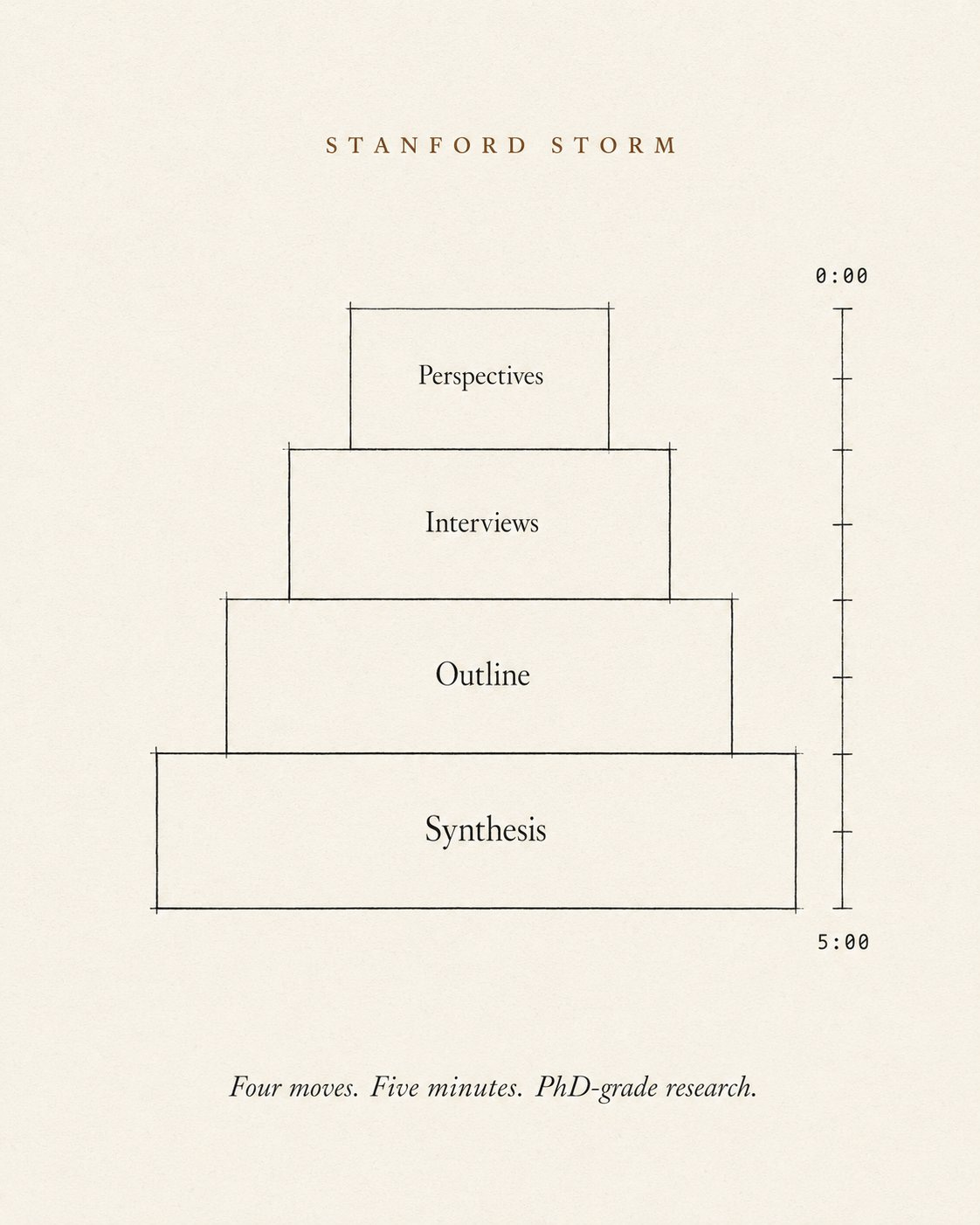
Here’s the bigger secret: you don’t need any of the software. The Stanford method is really a way of thinking, and you can run that same thinking inside Claude with four copy-paste prompts. No GitHub. No setup. Five minutes.
What follows is the full method, broken down into the exact prompts
Why one prompt will always fail you
When you ask Claude “tell me about X,” you get the majority view. The most common framing. The surface.
What you don’t get:
The practitioner who works with X every day and sees what books miss
The skeptic who thinks the entire mainstream view is wrong
The economist who follows the money and exposes hidden incentives
The historian who has seen this exact pattern before and knows how it ended
The academic who actually read the studies, not just the headlines
Those five voices see five different things. That’s what a PhD student does. They don’t ask one question. They ask five, then map where the answers fight each other.
The Stanford paper proved this with numbers. Multi-perspective questioning catches the blind spots that single-prompt research never sees. A PhD-level research job normally takes 40 to 60 hours of human reading. STORM compresses it. The four prompts below compress it further. Five minutes total.
Prompt 1: The Multi-Perspective Scan
The heart of the method. Paste this into Claude. Replace the topic in line one.
I want a research-grade understanding of: [TOPIC]

Don't give me the standard overview. Instead, write five
distinct perspectives on this topic from the following voices:

1. The PRACTITIONER who works with this every day.
   What do they know that books miss?

2. The SKEPTIC who believes the mainstream view is wrong.
   What's their strongest argument?

3. The ECONOMIST who follows the money.
   Who profits, who pays, what incentives are hidden?

4. The HISTORIAN who has seen this pattern before.
   What past event does this echo and what happened next?

5. The ACADEMIC who has read the underlying research.
   What do the studies actually say vs. what people
   claim they say?

Each perspective should be 4–6 sentences. Be specific.
No hedging. Write as if each voice were speaking directly.
What comes back: five very different reads of the same topic. The practitioner sees what the academic misses. The skeptic challenges what the practitioner assumes. The economist exposes incentives the academic ignores. The historian provides patterns the economist can’t see.
Sixty seconds of work that catches what one prompt never finds.